Cuisinaire Strips
|
Introduction
Numbers are most often introduced by counting. But the use of "Cuisinaire strips" (and K. Stern's rods) introduces addition of numbers as addition of length, emphasizing a geometric interpretation of numbers. This approach tends to postpone naming the numbers and often serves as a preparation to a more formal approach. We use Cuisinaire Strips in a similar way, but with some differences. 1. Making a set of Cuisinaire Strips
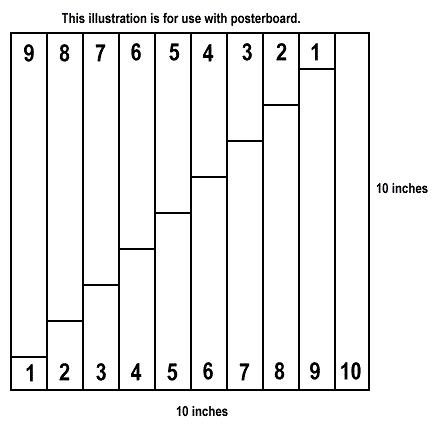
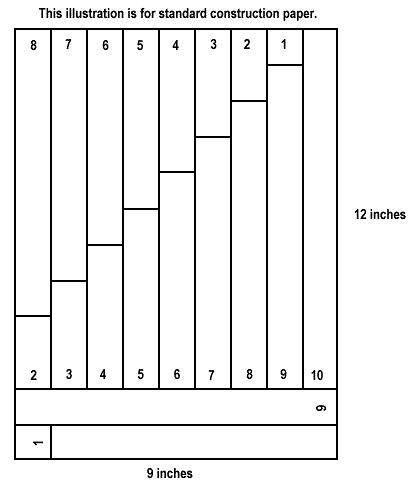
The teacher shows the students the pattern, and explains what they
have to do. The students draw the pattern; write the numbers; and cut
out the strips. They should write their names on the envelope and
close it with the paper clip. It is best if children sitting next to
each other use different colors of poster board (or construction
paper), so their strips don't get mixed up.
Remark The strips must not
be divided into one inch squares. The numbers describe the
length of each strip measured in inches. Students should confirm
this by measuring each strip with a ruler.
Arrange the nineteen strips you have into a square. Make other rectangles. What other shapes can you make? 3. Basic addition problems The total length of two strips may be equal to the length of a third one. In how many ways can you make a length of 10 inches from two strips? Here the order does not count, so we have 5 ways, 1 + 9,..., and 5 + 5. How many ways can we make a length of 9, 8,... inches? How to make a length of 10, 9, 8,... from three strips? 4. More addition problems Which combination of strips give the same length, for example, 14 inches? What is the total length of the strips, 3 inches, 5 inches and 7 inches? If you are not sure, measure it with a ruler. Can you solve some of these problems in you head, with your eyes closed? |